
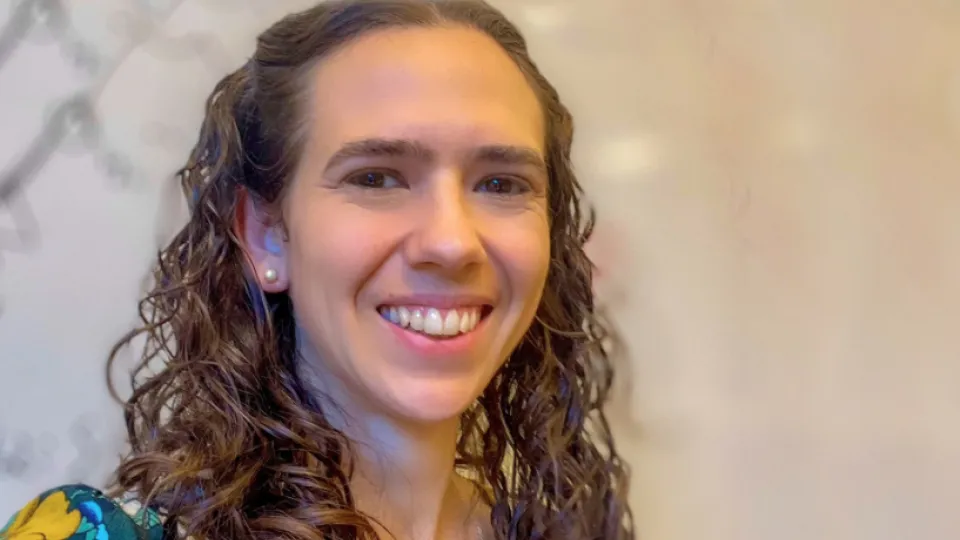
Susanna de Rezende has been working as an associate senior lecturer in Algorithms and Complexity at the Department of Computer Science, Lund University, since December 2021. Today, the happy news arrived: She got an ERC Starting Grant for her project META, Meta-Computational Perspectives on Proof Complexity. The project lasts for five years.
What does an ERC Starting Grant mean to you?
“It’s a game changer. It gives me the freedom to pursue an ambitious, long-term, high-risk, high-gain project, and to build a dedicated team of PhD students and postdoctoral researchers working exclusively on this project. I’m very grateful for the opportunity!” says Susanna de Rezende.
Susanna de Rezende completed her PhD at KTH, Kungliga Tekniska Högskolan in Stockholm, after studying computer science in Sao Paulo, Brazil. She currently holds a Wallenberg Academy Fellowship, and is part of the ELLIIT Excellence Center at Linköping – Lund in Information Technology.
Can you tell me a little about the project?
“One of the big questions in computer science is to understand how hard different problems are for computers to solve. Some problems can be solved very quickly, while for others we do not know any efficient algorithm. Computational complexity theory tries to understand this difference: what are the possibilities and the limits of computation?
“But there is a second, deeper question. Sometimes we believe that a problem is hard because nobody has found an efficient algorithm. But we also cannot prove that no efficient algorithm exists. My project asks why this happens. Why is it so difficult not only to solve certain problems, but also to prove that they are hard?”
“There have traditionally been two ways of analysing the potential and limits of computers. One is to analyse circuits, which model the tasks a computer can perform efficiently. The other is to study proofs, which capture the step-by-step reasoning behind an algorithm as it solves a problem.”
Why can’t we solve these problems efficiently, or prove that they’re hard?
Understanding the potentials and the limits of computers is the goal of computational complexity. But on some fronts, Susanna de Rezende says, “it feels like we’re stuck”.
“There are problems we can’t solve quickly with a computer, and we can’t prove that it’s impossible to do so. Why? Why can’t we solve these problems efficiently, or prove that they’re hard? We have some understanding of why our methods for analysing circuits have made limited progress. But we don’t really know why we haven’t made more progress by analysing proofs. That’s what I’m proposing to investigate: can we understand why we are not making more progress?”
What do you hope to achieve?
“This project takes a step back and looks at the methods we use to prove that problems are hard. I want to understand the power and the limitations of these methods. When do they work? When do they fail? And can we explain why?
“There has been a lot of progress on these kinds of questions in the study of computational models called circuits. My project brings this meta-level perspective to the field of proof complexity, which studies the length and structure of mathematical proofs. In simple terms, I want to understand the limits not only of computation, but also of our ability to reason about computation.”
What kind of problems can it be about?
“There’s a wide range of problems. Any problem that we can model mathematically. For example, an airline needs to plan routes and schedules for many flights. Each flight has to get from one airport to another, while respecting limits such as aircraft fuel capacity and airport capacity. We can represent those limits mathematically and ask: which valid schedule uses the least fuel, or which causes the fewest delays.”
Integer factorisation is another example, with implications for cryptographic security. Susanna de Rezende uses it to illustrate a problem that is believed to be computationally difficult.
“Multiplying two numbers is something we can do efficiently. We learned how to do this at school, and computers can multiply very large numbers quickly. But suppose we’re given the product of two large prime numbers and asked to find the prime factors. We don’t know an efficient way to do that—and we also can’t prove that no efficient method exists.”
The assumption that factoring is difficult underlies some of the cryptographic systems used in modern banking and e-commerce.
“We don’t know a fast algorithm for factoring, but we can’t prove that no such algorithm exists. Even so, the belief that factoring is hard is used as an assumption in some systems that protect communications with banks and online shopping. If someone found a much faster factoring algorithm, they would be able to break many of our cryptographic systems.”
Hackers’ heaven?
“Exactly.”
Susanna de Rezende grew up in a family where problem solving was part of everyday life. Both her parents are mathematicians, and she and her six siblings were often occupied with fun riddles.
“I have always enjoyed maths.”
The research project funded by the ERC Starting Grant explores fundamental questions in computational complexity about the limits of what computers can efficiently solve, and why it is so difficult to determine these limits. The focus is on why we sometimes are unable to find efficient algorithms for certain problems, but also unable to prove that such algorithms cannot exist. The project will examine the methods researchers use to analyse these questions, and the limits preventing further progress. Susanna de Rezende hopes that studying these methods may reveal new ways of understanding the potential and limits of computation.
“It’s all very exciting! I don’t know exactly where this project will lead, but I believe it will lead to some very interesting discoveries.”
Susanna de Rezende’s profile in Lund University Research Portal